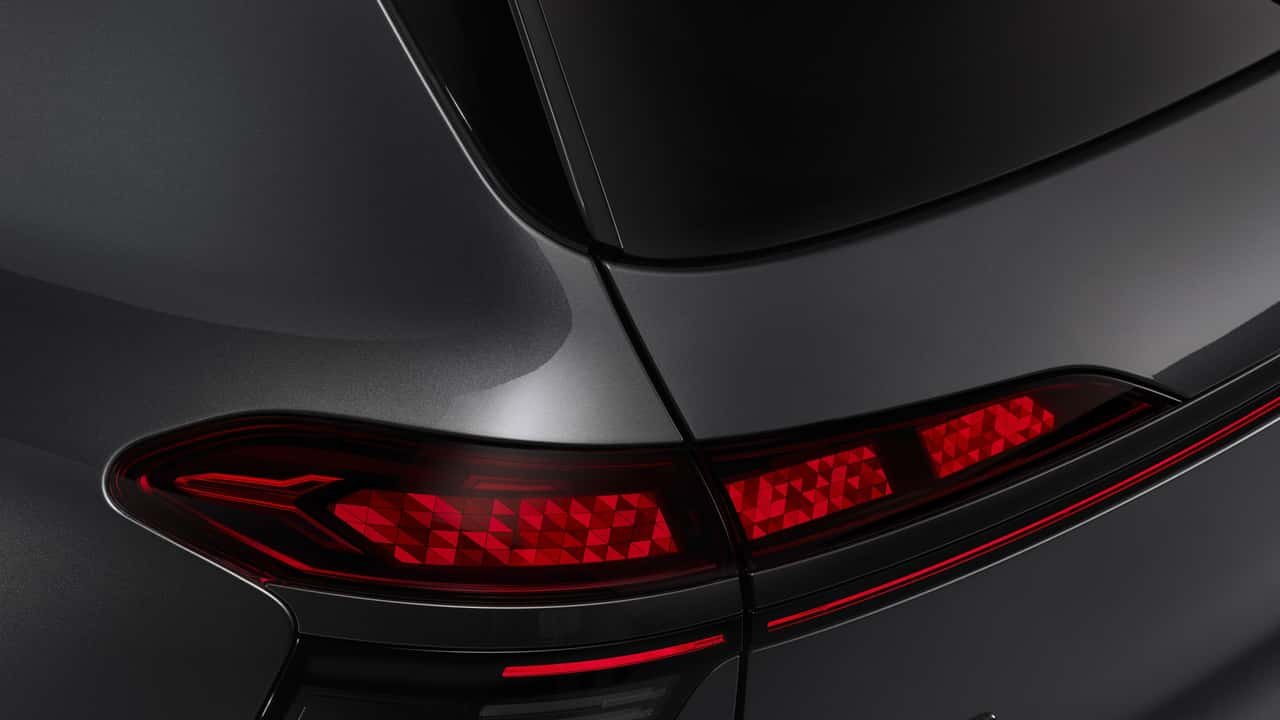
Audi’s new flagship SUV features an innovative lighting setup that sets it apart on the road. Introduced during the vehicle’s debut this past July, the Q9 utilizes curved digital OLED taillights built from six ultra-thin glass panels. Measuring just 0.1 millimeter thick, these flexible panels wrap directly around the rear quarter panels instead of remaining completely flat, a design Audi claims as a world first. That link lets hundreds of segments be controlled on their own instead of lighting up as one block.
The underlying hardware incorporates 512 individually controllable lighting segments across the six panels, giving the full-size SUV an advanced visual signature and improved illumination.
How the Curved OLED Taillights Work
Traditional LED taillights rely on flat lenses, restricting how far around the vehicle body the light can seamlessly flow. Audi’s curved digital OLED technology overcomes this by shaping the glass substrate to contour with the Q9’s rear quarter panel, allowing illumination to follow the sculpted exterior lines. Which limits how far the light can wrap around a car’s body. Audi’s curved digital Q9 flagship SUV changes that by shaping the glass substrate itself to match the rear quarter panel. The lighting follows the curve of the body instead of stopping where a flat panel would, conventional LED taillights sit behind flat lenses.
Because the 0.1-millimeter glass substrate bends without damaging the bonded OLED layer, the entire light assembly measures just one millimeter thick. This design builds on a decade of lighting development by Audi, which previously became the first automaker to introduce segmented OLED lights to production vehicles.
In the Q9, each OLED component connects directly to the central control unit via a bus system. This configuration allows individual control over hundreds of distinct light segments, rather than operating the panel as a single unit. The wrapped design also improves lateral visibility, ensuring drivers approaching from side angles at intersections or parking lots receive a clearer view of the turn indicators and brake signals compared to standard flat lights.
A Light Show on the Road
The six-panel rear configuration is distributed across the tailgate and outer rear fenders. Audi notes that the outer curved piece on each side represents the largest rear-lighting panel the automaker has ever manufactured. The complete segment allocation across the vehicle includes According to the six-panel layout splits the lighting across the width of the tailgate and rear quarter panels. Audi, The outer curved panel on each side is the largest rear-light panel it has built. The breakdown lists 99 segments for each outer panel, 84 for each central panel, and 73 for each inner panel, which adds up to the 512 total segments across all six pieces.
- Outer panels: 99 segments per side
- Central panels: 84 segments per side
- Inner panels: 73 segments per side
Together, these individual zones total 512 controllable lighting segments across all six pieces.
Up front, Audi pairs these advanced rear units with digital Matrix LED headlights. At night, the two systems operate in tandem, enabling the Q9 to project a stylized turn-signal pattern onto the road surface ahead, synchronized with the dynamic front and rear indicators. Audi previously previewed this turn-signal pavement projection on the Q7 before equipping it on the flagship Q9.
While Audi confirmed the panel counts, 512-segment total, and glass thickness during the Q9’s reveal—and currently offers digital Matrix LED headlights on select US models—certain operational details remain undisclosed. The automaker has not yet specified how much personalization drivers will have over the 512-segment setup or whether all global markets will receive identical startup and shutdown lighting sequences. These functional features and US pricing details are expected closer to the vehicle’s official market launch. Or whether every market gets the same signature lighting sequence at startup and shutdown, what Audi has not detailed yet is how much of that 512-segment system drivers can customize through onboard settings.