Low-tension piston rings are standard in many performance and racing engines, yet ring tension remains a nuanced subject. Selecting oil ring tension requires more than choosing a catalog figure. Builders must understand the origin and meaning of these measurements to select the proper ring package.
In a recent video, Keith Jones, Director of Technical Sales at Total Seal, examined oil-ring tension and compared it against standard shop testing methods. The critical factor is distinguishing between force and friction, as these represent distinct aspects of ring operation.
Evaluating True Ring Force
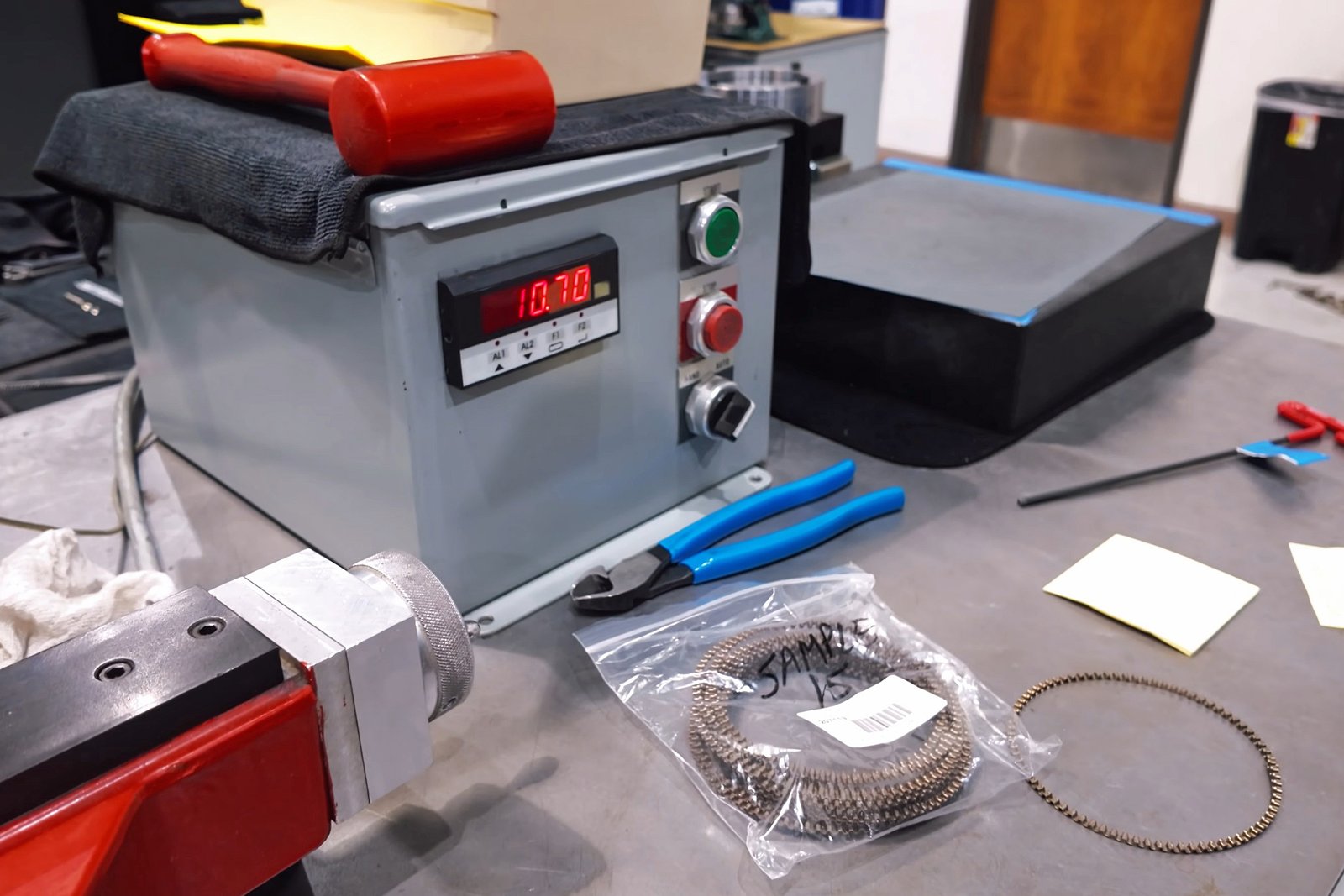
What do specific tension ratings like four or ten pounds represent, and how are they determined? Total Seal utilizes a specialized load-testing tool nicknamed Big Red, which the company has employed for over 25 years. This machine measures pound-force, specifically the effort required to compress a ring assembly to a target bore diameter, rather than measuring friction.
The test uses an oil-ring assembly designed for a 4.195-inch bore, calibrated against a master gauge of that exact size. A slip ring is placed around the oil-ring assembly, which consists of an expander and rails mounted on tooling that replicates the piston’s oil-ring groove, before the machine compresses the slip ring to the specified bore diameter.
To prevent inaccurate readings, the tooling is kept smaller than the assembly, ensuring the slip ring only touches the oil-ring components. The testing process also incorporates vibration to eliminate friction between the oil-ring rails and the slip ring, allowing the machine to isolate the force needed to compress the assembly.
How Expander Adjustments Impact Tension
Initial testing focused on a 3mm oil ring setup, generating roughly 10.5 to 10.7 pounds of force. Using a larger expander raised this force while following the same testing protocol. This second configuration hit the expected 12.3 to 12.4 pound range, marking an increase of about two pounds. Notably, expander output does not always align with theoretical expectations.
Jones clarified that an expander functions as a spring rather than a ring.
As spring components, expanders can show batch-to-batch variation. Swapping expander sizes does not ensure consistent results. A revealing test highlighted the sensitivity of these springs to physical alterations. Researchers removed one full section from an expander that initially registered about 10 pounds of force, then re-tested the modified component.
The outcome was significant. Rather than maintaining just over 10 pounds, the altered expander generated only about one pound of force. Eliminating even a minor section drastically reduced the spring length and fundamentally changed its operating traits. This serves as a cautionary tale for engine builders who modify oil ring expanders, as minor adjustments can lead to massive fluctuations in force.
Measuring Ring Drag in the Workshop
Few builders possess the specialized load testing equipment utilized by Total Seal. The unit featured in this demonstration cost roughly $22,000 during its purchase in the early 2000s. Jones notes that acquiring similar testing hardware requires a substantial financial commitment.
Builders can perform a practical shop test to assess oil ring packages. This technique, commonly known as “fish scaling,” involves using a low-cost hanging or digital scale. The test requires only the oil ring assembly installed on a piston, with the compression rings removed. After placing the piston into a dry cylinder bore, the builder attaches the scale to the wrist pin and applies steady tension to pull the piston through the bore while monitoring the force output.
The initial breakaway reading should be ignored, as overcoming static friction requires significantly more effort than maintaining motion. Breakaway force might peak at 15 to 20 pounds, while the continuous pull force may only register 10 to 12 pounds. Builders should focus on the force needed to keep the piston moving. Keep in mind that this method provides a measurement of total friction rather than direct ring force.
How Bore Texture Alters Data
Total Seal describes the “dry-skidding test” or “fish-scaling” as a measurement conducted without cylinder wall lubrication. Unlike a load tester, this technique incorporates the cylinder surface texture into the results. A rougher bore increases drag, leading to higher scale readings, whereas a smoother bore decreases drag and results in lower readings, even when the oil-ring assembly itself remains constant. Consequently, the cylinder finish acts as a primary variable when evaluating data.
Jones shared a case where a customer replaced their oil-ring package, believing the initial tension was too high. After the customer subsequently altered the cylinder bore finish, the test readings shifted inversely. This proved the ring itself was not the source of the variance; rather, the modified friction characteristics of the bore surface caused the change in the scale readings.
This highlights why Total Seal avoids the dry-skidding method during manufacturing. To accurately determine the force needed to compress a ring assembly to a specific bore diameter, the company must exclude cylinder-wall friction, as it would introduce an uncontrollable variable into the measurement process.
Distinguishing Force from Friction
While fish-scale tests serve as a practical comparative tool for engine builders without specialized load-testing equipment, they do not function as a substitute for precise laboratory-grade measurements of ring tension.
A load tester quantifies the force required to compress the ring assembly to a designated diameter. Conversely, a dry-skidding test measures the friction generated while pulling that assembly through a specific cylinder finish. Therefore, variables like ring configuration and surface texture directly influence fish-scale results.
Understanding this difference is vital when evaluating ring packages or investigating drag issues. The expander experiment shows that minor adjustments can significantly alter actual ring force. Always verify exactly what a test measures rather than focusing solely on the final numerical output.
If you are uncertain about the appropriate oil-ring tension or ring package for your specific engine application, contact Total Seal for professional guidance on selecting the correct combination.